Powered By Blogger

Tuesday, July 22, 2008

Young Oak Vineyards - Vol. 17: Water Consumption

Hi all:

Hey, It's my son's birthday! Happy 28th Birthday, Scott! He is currently off traipsing around Kyrgyzstan on a holiday! But Katie, my 16 year old daughter, will be visiting Scott in Finland in a week, where he currently resides.  He has planned a world-wind trip for them, flying to Budapest, then by train/car to Bratislava, Vienna, Salzburg, Munich & Frankfurt, visiting friends along the way! Then flying to Estonia to ferry back to Helsinki! Sounds like a
John Candy Movie  or Mel Brook's  If It's Tuesday, This Must Be Belgium!

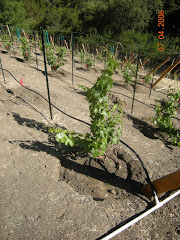
Closer to home, just look at those grapevines! My youngest daughter, Suzie, is 5' 7" and several of the vines are almost as tall as she is.

As we had in Palo Alto, we have the wonderful, but contriversal
Yosemite/Hetch-Hetchy West Bay water up here in Los Altos Hills. Since we moved here, our home water usage has been about 8 WU per month (water units, where 1 WU = 100 cubic feet of water). Hey, that is on the lowest usage billing tier, for anyone who is checking on my water conservation during our drought, by the way! Also, we don't have any landscaping, just weeds!

Well, after the March vineyard planting, our water usage has gone up to an average of 18 WU per month with a high of 30 WU during the May/June 2008 heat waves. Cutting to the chase, it was costing $25.63 per month, on average, to water the grapes
by hand, using about 7,500 gallons a month. This has really allayed my fears of horrendous, multi-$100 water bills!

Also, we started using the drip system over 4th of July weekend, watering for 4 hours (at one gallon an hour) every 4-5 days or even longer. That would be about only 6,000 gallons a month. That is a reduction in our current usage by about 20%. We will just have to wait & see if we have any $20.50 per month bills in the future!

The featured musician of this edition of the Young Oak Vineyards Blog is
Ottmar Liebert with "Bullfighter's Dream". Ottmar is a extremely talented German guitarist, first starting as a rock musician, then becoming one of the world most foremost Nouveau Flamenco guitarists. He has a great website with a diary blog (just like me!!), lives in Santa Fe, New Mexico, US and is into environmentalism, Buddhism & photography among his many other creative talents & interests!

Bullfighters Dream - Ottmar Liebert
Drinking Mojitos & wishing you well from down in the vineyard,
John

Tuesday, July 15, 2008

Young Oak Vineyards - Vol. 16: Wine & Music !!

Hi all:

One month into summer and I have so many projects still to complete. But the grapevines just keep growing & growing down in the vineyard and there has been no sign of the deer coming back after we patched the "hole" in the fence. It is truly amazing, considering we just planted these vines 135 days ago. My watering system still has some bugs in it, but I am slowly addressing the non-cooperative emitters and the faulty plastic tubes as the former clog and the latter leak.

Needless to say, I have had more time to work on the old Chateau du Sphar. Daughter Suzie now has new halogen track lighting washing her walls and soon her sister,Katie, will have same. Perhaps, Kristen will even get new bedroom lights soon!!

As you have probably noticed by now, I have added a music widget to the "Young Oak Vineyards Blog". I find this initial piece by
Pat Metheney, Sueño Con Mexico, to be very soothing. Pat is a most eclectic guitarist who experiments with many different styles & sounds. I hope you will enjoy it.Sueño con Mexico.mp3 - Pat Metheny -
Forgot to mention a couple of weeks back, we attended a very enjoyable wine bottling of a Petite Sarah blend at
The Bacchus Winemaking Club in San Carlos. Very Interesting facility located on Industrial Road off of Whipple Road. The owner also bottles his own line of award winning wines as the Domenico Winery at the same location.

Wishing you a wonder-filled mid-summer from down in the vineyard,
John

Thursday, July 10, 2008

Young Oak Vineyards - Vol. 15: Vino Locale

Hi all,

Since I have finished the vineyard watering system, I now have time to do other things, like go to lunch with my dear friend,
Lynn Fielder. We went to Vino Locale, which features meals made from local foods, featuring local wines & local artwork. Lynn displays her jewelry creations there and is instrumental in selecting the featured artists.  (Click Lynn or Vino Locale to see their websites.)   It was great catching up with Lynn. Her family has a Finnish heritage & connection, hosting a Finnish exchange student a few years back, which has been a great contact for my son Scott, who did his masters there and now resides in Helsinki.

Lynn & I had a fabulous lunch and sampled a flight of local Pinot Noirs. We started with the "Crostini Sampler" with home grown pesto and a wonderful pâté, followed by delicious grilled tri-tip sandwiches and completed with petit mocha cheesecakes.
Vino Locale has a great wine cellar of small (& some not so small) local wineries within a 75 miles radius of Palo Alto. I highly recommend a visit to this wonderful restaurant !!

Regards, John

Sunday, July 6, 2008

Young Oak Vineyards - Vol. 14: The Trellis's Are Up!!

Hi all,

Hope you all are enjoying a great 4th of July weekend! Having the summer off has allowed me to do a lot of projects at home, and we have made a lot of progress in the vineyard as well. We have finally put up the trellis wires and now you can see why we put the posts in at an angle, to pull against 75 feet of wire and eventually the weight of the fruit ladened vines! I must say, the vineyard is really taking shape!

Many vines have reached over two feet in height and a few are even four feet. Several vines have developed green, unripened grapes berries about one centimeter in diameter (that's 0.4 inches for you non-metric folk).

I had intended to use grow tubes to protect the grapevines from the critters, however, Ron of Vinescape suggested I just allow the grapevines to grow unpruned and unfettered, to allow the root system to fully develop over the first year. Generally speaking, the root system below the ground is about the same size as the foliage is above ground. To use the grow tube, you have to prune the grapevine down to only one shoot, which you would train up as the trunk of the vine. For this we will wait until the late Fall / Winter season when I will learn about pruning.

A couple of days ago, when I was working with a couple of my amigos, five deer came wandering into the vineyard under my neighbor’s deck. This answers my question of how these guys have been getting in and browsing on the grape leaves. Now that we have plugged that leak, hopefully we have eliminated our deer problem!

Keepin' it "Safe & Sane" in the vineyard!
John

Tuesday, May 27, 2008

Young Oak Vineyards - Vol. 13: Neighbor Mark Vernon Reports Big News!!!!!


Hi all,

Mark Vernon, Ridge Winery COO and neighbor extraordinaire, has reported to me that "green things" (leaves) are emerging from the sawdust inside the milk cartons, which you can see to the left.   

Congratulations
, Mark!  That heat wave probably got the grafts & rootstocks going PDQ.

Regards, John  

Saturday, May 24, 2008

Young Oak Vineyards-Vol. 12: Emerging Tendrils!!


Hi all,

Working down in the vineyard this Memorial Day weekend, I was reminiscent of another life, in another world, at another time thanks to the recent Moffet Field Air Show.  As I looked up to the blue sky, I saw a B-17 Bomber lumbering by the clouds and I thought I could be a Frenchman working on his vineyard in German occupied WWII France watching the Americans looking for a German tank convoy!  Here's to the men & women of our armed services, past and present.

Above you can see the new grapevine tendrils (v shaped structures in my palm) emerging from the new leaf grow looking for something to grab onto, coil around & support future growth.  It is amazing  & miraculous how the cells of the plant differentiate into new and different structure just as our stem cells differentiate into the different tissues and structures of our bodies!

Now that I have received my "Gripple Tool" & my pink "Grow-Tubes", I have a flurry of work to do to put in the trellis wires in the next couple of weeks to help encourage that growth.  So we will have lots to report in the near future.

But this weekend I just had to go camping at Foothill Park with my youngest daughter, Suzie, and some of the great Escondido families to share stories around the campfire!  Hope you too had a great Memorial Day weekend.  Wishing you and your families are all well, especially those with members in the armed services.

Regards from down in the vineyard,
John

Monday, May 19, 2008

Young Oak Vineyards-Vol. 11: Its Growing Season!!

May 18, 2008


Hi all:

Well the heat is here! And we are at the start of our warm weather growing season. But these grapevines you have planted have not done too shabby during the early spring for the last 78 days. As you can see from the attached photo, we have several cane shoots in full leafy foliage with flower bud clusters as I am holding in my hand. These clusters will soon bloom into tiny flowers from which the fruit (grapes) will swell. I have attached a great photo montage from Michigan State University showing the stages of grapevine development. Check it out:


http://www.grapes.msu.edu/pdf/Growthstages.pdf


Next time we will be pruning down to one main shoot on each grapevine and putting on a growth tubes. I ended up purchasing the pink ones (Paris Hilton, you win), but more about that later. I should be receiving them next week, along with my "Gripple" tensioning tool! My neighbor, Mark Vernon, had the super crew from Vinescape plant last week with very interesting techniques to protect the grafted rootstocks. Each rootstock is protected by an empty milk carton, open on each end. Further, the planted rootstock is covered with sawdust inside the milk carton. Those guys really know what they are doing!

Trying to stay cool down in the vineyard,
John

Young Oak Vineyards - Vol. 10: Now, That's A Vineyard. !!!!

March 30, 2008

Hi all,

Not much to report at the end of Spring Break at Young Oak Vineyards, but it sure is looking like a vineyard!  The attached photo was taken from my dilapidated balcony off the living room.  It was a lot of back breaking work, but we made all the little terraced moats around each grapevine for the drip rings of the watering system.  The grapevines are all starting to show healthy leaves, although a couple didn't make it and will need replacing.  We are going to start to put in the support wires for the the trellises, soon, after I purchase my "GrippleTool".  Check out their website animations under the "trellising" section for "looping around an end post":

http://www.gripple.com/agriculture/flash/

Gotta love new technology !!

My neighbors Mark & Dianne Vernon, have retained "Vinescape" to install 100 vines adjacent to our vineyard.  I can't wait to see what I am doing wrong when these pro's do their thing.  They started laying out the vine rows with a laser!!  I have to say that some of our planters were not quite laser straight, so we had to move a few of the grapevines!

Hope you all had a nice Easter, restful break and /or a pleasant rite of spring! 

Best wishes from down in the vineyard,
John

Young Oak Vineyards - Vol. 9: Botany !!!?!

March 26, 2008

Hi All:

I have to make a confession now.  When I applied for my bachelor's degree in biology, I had never got around to taking botany, a required class for the degree.  Since I was entering the graduate program at the same institution, they gave me my bachelor's anyway, but required me to take botany as a graduate course before I could advance in my master's program.  At about half of a semester into graduate program, I grew weary of another 2 to 3 years of college, so withdrew and follow my nose into the field of ?:

But that is a whole other story, for another time!  So, now that I am actually teaching biology, and we do cover botany, I kinda have to get my pistils and stamen straight!  Fortunately, I have picked up a few things about plant physiology here and there.  And depending how things work out this summer, I may get to spend a week at Texas A&M doing some teacher field work on botany research, where my other good old (long?) friend from kindergarten, Duncan MacKenzie, hangs his hat.  This is from the Texas A&M website "Yell" section:

AGGIE YELL [Hands flat, with index fingers and thumbs touching to form an "A"]

A-G-G-I-E-S , A-G-G-I-E-S,
 Aaaaaaaa , Fight 'em, Aggies !!!!!!!!!!!!!!!!!


Texas & Football, what can I say!  

Well , the grapevines buds are growing with each day of sunshine.  And the leaves are now forming, as you can see from the attached photo.  With the watering system in place, with a big thanks to friend of the family Gary Fine lending a hand this last week, the concern now shifts to survival.  The deer should be kept at bay by our fencing albeit only six feet tall.  And the gophers actually do not eat the grapevines, but are more of a menace to the root system, so we don't expect too many loses there.  But the big concern are the rabbits!  Other than Elmer Fudd's approach, anybody have good ideas?

On vigil down in the vineyard, John

Young Oak Vineyards - Vol. 8: Thank You !!!!!!!!!!!!!!!!!!!!!! and more !

March 18, 2008
Hi All:

For those of you who did not get the e-Vite "Thank You !!!!!!!!!!!!!!!!!!!", well thank you for all your help and encouragement! With the help of our many friends & family, we have established a small family vineyard. The initial soil preparation was done in the Fall & early Winter of 2007. Then, 200 Cabernet Sauvignon grapevines were planted on March 1, 2008 by over 50 friends & family members in less than two hours. It was a great day, with a little work, great friends, great food & great drink! Please enjoy our on-going journey as we learn, build and share our experiences!

Best regards to all,
John
Post script:
The vineyard is quiet with only the noise of the March wind as we past the "Ides", waiting for the warmer weather to begin. You know, the "Ides" was just the Roman 15th of any month (mid-month) until Julius Caesar was assassinated on the "Ides of March". And then, Shakespeare went and re-told the story, making it a day of impending doom! ($700 worth of grapevines and nothing is growin' !!)
But wait, we have had some nice rain and some warm days! And yes, the sun has been out a lot! Well, to borrow a line from Dr. Frankenstein:

Blank


Yes, this weekend almost every grapevine has budded with 1, 2, 3, 4, even 5 buds! I have attache a picture of one of the grafted shoots and there, opposite my finger, a third way up from the root stock graft is a big bud. There is also a smaller one on the base of the shoot below my finger.

As you can see in the picture, along my arm we have put in the main drip lines along each row. I am still plumbing away to get the entire watering system connected, so I don't have to water by hand much longer!

So, I will keep you posted as things progress in the Spring. We will finish the watering system in a week or two. Then, the trellis wires are going in. And finally we have to have the discussion about "Grow Tubes"!! Should they be blue or pink!! And it is not a decision for Paris Hilton!

Regards from the vineyard,

John

Young Oak Vineyards - Vol. 7: Trelli?

February 24, 2008

Hi all:

As my son noted to his friends on their Christmas sojourn down the Baja California peninsula in our RV last year, the singular and plural forms of those succulent desert plants are cactus & cacti.  So why not trellis & trelli, instead of trellises?  At any rate, we are down to our last task of the vineyard preparation before our planting party, and that is the trellises!

Over the years, I have observed many, many vineyards, usually while driving at 70 mph going somewhere on vacation.  But for the last couple of years, I have been slowing down and even stopping, to the annoyance of my kids, trespassing on private property and making a lot of measurements of the vineyard rows, trellises & spacing variations, particularly the ones around the Palo Alto Hills & Los Altos Hills.

What I have gleaned from this exercise and from my many conversations with knowledgeable acquaintances, is that a lot of consideration for vineyard layouts comes from a balance of mechanization, the lay of the land & the best orientation for the grapevines.  In the old days, typical vineyards in Napa had rows that were 8 or even 10 feet apart, mainly for passage of large tractors, like a D-9 Caterpillar.  Grapevines were placed 6 feet apart along the rows, so they had plenty room for growth.

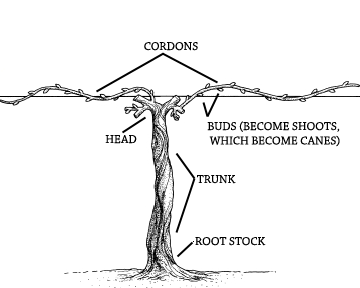
But modern vineyard practices have put an emphasis on creating a balance between the good nutrient supply from the sun & roots and stress on the vines by crowding them slightly, forcing adjacent vines into competition, giving the grapevines what the growers call "vigor".  So we have decided to lay out our trellis rows at 6 foot widths with the grapevines 4 feet apart, in the hopes of producing a better wine grape.  We are using what is called the two-wire trellis system and as the grapevines grow, we will use the cordon method of pruning, which is similar to ornamental espalier pruning (flat pruning) along a trellis or wall, like the diagram shows, but involves very careful pruning at specific locations along the canes & at specific buds.

Fourth season
At the planting party, after we plant the grapevine seedlings, we will be tying a piece of twine loosely around the main shoot of the seedling and draping it up to the trellis wires to train the main shoot to grow into the trunk after the first or second year of growth.  

But we are getting  ahead of ourselves about what will happen at the planting party, so we will save that for next Saturday!  I hope you have enjoyed these e-mails as much as I have enjoyed writing, plagiarizing & copyright-infringing them!  To our family & friends who cannot be with us on March 1st, we will all raise a glass and know that you are with us in spirit!

Best regards from down in the vineyard, John

Young Oak Vineyards - Vol. 6: Preparing the Soil

February 20, 2008

Hi all:

An acre, from the Old English for an "open field", is defined as the amount of land that is tillable by one man with an ox drawn plow in one day.  Well, I could have used that ox this last week!   I had trouble finding someone willing to disc our field this early in the season.  And although the weather has been pretty dry for last couple of weeks, it is dangerous to operate a wheeled tractor on a slick hillside.  What I needed was a "crawler tractor" with treads like a tank, but the few tractor services around here were unable or not willing to start this early.  As I was panicking about what I could do, I actually found a community college professor in Marin County who plows his own fields with his team of Clydesdale horses (holy Budweiser!), but the logistics of moving his team of horses was not possible.

Finally, I found a "Ditch-Witch" crawler tractor with a 48" wide rototiller attachment (see picture above) and just before the rains of this last Tuesday, I was able to rototill our field, which begs the question, why do we till or plow.  According to one source, "plowing prepares a seed bed, controls weeds, turns under crop residues, weeds, composts organic matter into the soil. In, addition, plowing helps regulate soil ventilation, moisture, temperature, and makes plant food more readily available to the planted crop."  That's a mouthful!

Some 5000 years ago some prehistoric farmer got the idea of hitching his ox to his digging stick.  Primitive stick plows still are used in some parts of the world. The ancient Romans shod the point with iron or bronze to protect it from wear.  The Dutch improved the Roman plow, who needed a different shape for their soils. The colonial plow was a heavy wooded & wrought iron 10' long beam.  It took several teams of horses or oxen to pull it & often needed repairs. In 1797, a plow of solid cast iron was patented in New Jersey & soon after Thomas Jefferson invented one which could be pulled more easily.  In the western expansion of North America, this plow could not successfully break the tough sod formed by the matted roots of the prairie grasses.  Even with 5-10 oxen pulling, the sticky black soil clung to the plow and had to be scraped off every few steps.  John Lane made a plow with polished steel circular saw blade which would "scour" the soil off the plough without cleaning (what we know as discing today). In 1837, John Deere, a blacksmith of Grand Detour, Illinois, made further improvements and founded the now famous farm implement company.

But plowing, on the other hand, releases a lot of carbon into the atmosphere, so there is a big movement in the farming community to sequester greenhouse gases from the atmosphere by plowing as little as possible increasing the carbon content of the soil.  This is probably the last time we will turn the soil in the vineyard.  After we plant we will propagated specific species of native grasses that act as ground cover around the grapevines and only "weed-wack" them down seasonally.

One more thing to do before we plant and that is to get the trellis set up and we will discuss that next week!

Regards, John

Young Oak Vineyards - Vol. 5: Grafting Clones

February 17, 2008

Hi all:

GRAPEVINEWe left off with the question of what is a grapevine "clone". Sounds like something from "Dolly the Sheep" !! But "vegetative cloning" has been done for thousands of years. The earliest record of grafting is from China around 5,000 B.C by a diplomat's work on peach trees. The Romans were famous for their grafted olive trees.

A "vegetative clone" is a plant that has been reproduced without a seed, directly from a bud or a shoot. In fact, the Greek origin of the word "clone" means "twig". This asexual method of reproducing guarantees that the offspring will be genetically identical to the original single parent plant.

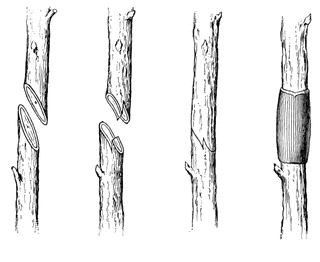
To do this in grapevines, a cutting is made from a shoot, the new growth from the cordons that become the fruiting canes of the desired grapevine (see diagram above), and then grafted, literally spliced together, to a desired grapevine rootstock shoot (see diagram below). Care is taken that the root side of the cuttings are oriented downward and the leaf sides are oriented upwards, so that when the grafted cutting is placed in the soil root side down, it will sprout roots and the leaf side will sprout leaves. And so it is allowed to propagate in a nursery, and then the new little plant is potted for planting in a vineyard.
Grafting
In our case, the "Foxy Grape" rootstock that Duarte Nursery currently had available was #3309C with the Vitis vinifera Cabernet Sauvignon Clone #06 grafted to it. This clone was developed in Jackson, California as a "Good Blending Choice For Ultra-Premium Wine Programs" [Link to Duarte's Facebook Page]

I have listed Duarte's notes below:

Attributes - Good choice for diversification. Lowest yielding cab clone (60% of Clone 7 or 8). Best on high density spacing. Excellent wine quality. High skin to pulp ratio. Small to medium size, loose clusters, variable size berries

Tasting Notes - Aroma: vanilla, black olive, soy, cinnamon, clove. Flavor: berry, olive.

This is a really nice, high quality Cabernet Sauvignon grape. Its yield (the number and size of grapes) is less than other clones, but the wine it produces is superior. The #3309C rootstock needs good drainage and I think that with our slope we will have that. And although it is not the "La Cuesta" clone, this is a really high end grape used in very fine wines! Sounds good to me, so ... , this is what we bought and what you will be planting in 18 days!! My son, Scott & I will be picking up our vines on Friday, February 29th, fresh from the nursery !! They are already propagated little potted plants, that can be planted anytime of the year, so let's do it !!

Regards from down in the vineyard, John Sphar

Young Oak Vineyards - Vol. 4: Rootstock

February 10, 2008

As I had previously mentioned, our soil results were reviewed by the good folks at Ridge, particularly David Gates, V.P of Ridge Vineyard Operations.  David had commented about the suitability of our soil for specific grapes, either Cabernet Sauvignon or Zinfandel, and then he recommended 6 different grapevine rootstocks that would be compatible with our soil.  Which gives rise to the question, what is a rootstock?

First a little background information.  The native grapes of North America, generally known as 
"Foxy Grapes", don't make particularly good wines.  And the grapes grown in Europe, Vitis vinifera, which make really good wines, didn't & don't do very well when they tried to grow them here, recorded as early as the 16th century by the French in their new colony, Florida.  Even Jefferson had difficulty growing grapes at his beloved Monticello.  He planted more than 24 European grape varieties, and considered wine was "necessary of life".  But as noted in his Garden Book, constant replanting of the vines indicated that they didn't grow well and there is no record of wine ever being produced.  Further, he noted that growing grapes for wine was "like gambling".  By the way, during 1801, his first year as President, Jefferson spent $2,262 on imported wine, more than he did on food.  Presidents of the time were required to furnish food and drink for the President House staff and guests out of their own salaries.  During his eight years in office he spent $10,955 on imported wine; in 2008 currency that would amount to more than $175,000.

It turns out that the 
Grape Phylloxera, or Daktulosphaira vitifoliae, a native North American aphid, killed off the European grapevines when they were grown here.  Our little aphid would eventually spread to Europe by 1870's, almost destroying the French wine industry.  Too make a long story short, our North American native grapes, are resistant to Phylloxera.  Eventually, someone figured out that the European grapevines, Vitis vinifera, could be grafted onto these "Foxy Grapes" roots, which made it possible to grow European grapes here.  Too bad the French didn't listen to Spanish, who were grafting Spanish grapevines onto Mexican native rootstock as early as 1524.

Armed with my list of recommended rootstocks,  I did a Google search for grape rootstock and found 
Duarte Nursery, located near Modesto, CA, which happens to be "the place" to go for wine grapes rootstocks.  I wanted to find one of my recommended rootstocks grafted with the "La Cuesta" Cabernet "clone", which gives rise to the question, what is a "clone" and how do you "graft" it?  But I will save that for next time!

Regards from down in the vineyard (and it really is looking like a vineyard now!),
John Sphar